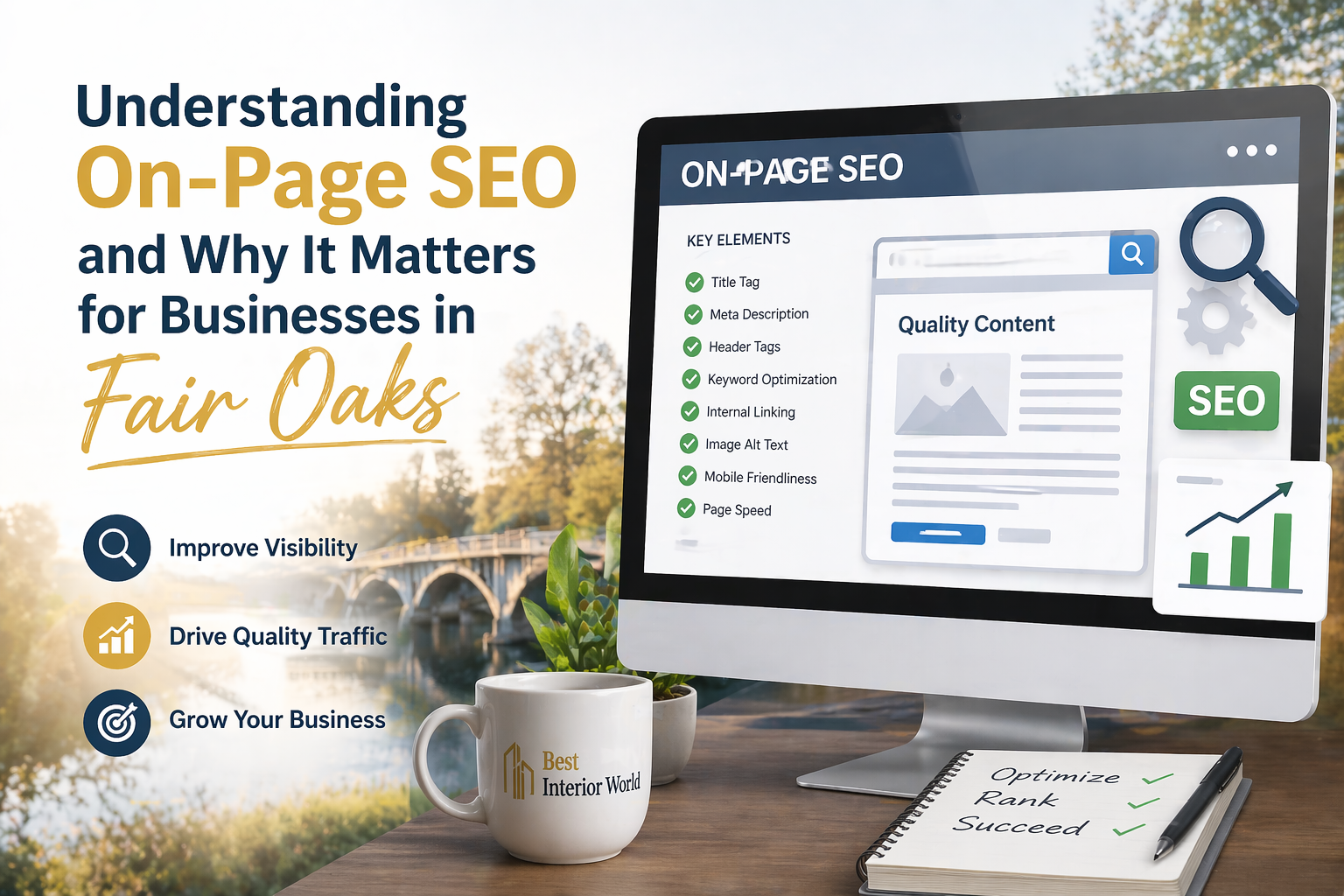
When a potential customer in Fair Oaks types a search query into Google, what determines which businesses appear at the top of the results? The answer involves dozens of signals, but one of the most fundamental is on-page SEO. For local businesses operating in competitive markets, understanding what On Page SEO Fair Oaks is, how it functions, and which elements matter most can be the difference between being found and being invisible online.
What Is On-Page SEO?
On-page SEO refers to the process of optimizing individual web pages so that search engines can understand their content and rank them appropriately for relevant queries. Unlike off-page SEO, which involves external factors such as backlinks and citations, on-page SEO is entirely within a business owner’s control. It encompasses everything from the words on a page to the technical structure behind it.
For a business in Fair Oaks, this means making sure that every page on the company website sends clear, accurate, and locally relevant signals to search engines. When done correctly, on-page SEO helps Google understand not only what services a business provides but also where it operates a critical factor for appearing in local search results.
What Does On-Page SEO Actually Include?
On-page SEO is composed of multiple layers, all working together to communicate relevance and authority to search engines.
Title Tags and Meta Descriptions
The title tag is one of the most influential on-page elements. It appears as the clickable headline in search engine results and tells both users and search engines what a page is about. Meta descriptions, while not a direct ranking factor, influence click-through rates by giving searchers a preview of the page’s content. For local businesses, including a location such as Fair Oaks within these elements can significantly improve visibility for geographically targeted queries.
Header Tags
Header tags H1, H2, H3, and beyond structure the content on a page in a way that is readable for both humans and search engine crawlers. An H1 tag typically contains the primary topic of the page, while subsequent headers break down subtopics. Well-organized headers make it easier for Google to understand the hierarchy of information on a page and help users navigate content quickly, which improves overall user experience.
Keyword Optimization
Using the right keywords throughout a page naturally and without stuffing helps search engines match the content to relevant queries. For businesses in Fair Oaks, this means incorporating location-based terms alongside service-related keywords. For example, a paving company would benefit from phrases that combine what they do with where they operate, so that their pages surface when local customers are searching.
URL Structure
Clean, descriptive URLs are another on-page factor that helps search engines understand page content. A URL that contains relevant keywords is preferable to one composed of random numbers or unrelated strings. It also makes pages easier for users to share and remember.
Image Optimization
Images contribute to user experience, but they also carry SEO value through alt text short descriptive labels that tell search engines what an image depicts. Properly optimized images also reduce page load times when compressed correctly, which is a performance factor that search engines consider when ranking pages.
Internal Linking
Internal links connect pages within the same website, helping search engines discover content and understand the relationships between pages. For businesses with multiple service pages or location pages, a strong internal linking structure ensures that all important pages receive attention from crawlers and rank well for their respective topics.
Page Speed and Core Web Vitals
Google places significant importance on the performance of a web page as part of its ranking criteria. Pages that load slowly, shift content unexpectedly, or respond poorly to user interaction are penalized in rankings. Core Web Vitals Google’s set of performance benchmarks measure loading speed, visual stability, and interactivity. Optimizing these technical aspects is considered a key component of modern on-page SEO.
Why On-Page SEO Is Especially Important for Local Businesses in Fair Oaks
Fair Oaks is a community within Sacramento County, and businesses here compete not only with each other but also with companies from surrounding areas appearing in the same search results. On-page SEO gives local businesses a direct lever to pull in order to signal geographic relevance.
When a web page consistently references the areas it serves, includes locally relevant content, and maintains accurate contact information including name, address, and phone number (NAP) search engines are better equipped to surface that business in front of nearby customers who are actively looking for its services. This is particularly critical for service-based industries where customers are searching with immediate or near-term intent.
Research consistently shows that the vast majority of consumers do not look beyond the first page of search results. On-page SEO, when well executed, is one of the most reliable ways to earn a position on that first page without relying solely on paid advertising.
What People Commonly Ask About On-Page SEO
Several questions come up frequently among business owners exploring on-page SEO for the first time.
Is on-page SEO a one-time task?
No. While a solid foundation can be built through an initial audit and optimization process, on-page SEO requires ongoing attention. Search engine algorithms evolve regularly, competitor pages are continuously updated, and business offerings change. Revisiting and refreshing page content, updating keyword targeting, and monitoring performance are all part of maintaining strong on-page SEO over time.
How long does it take to see results?
On-page SEO improvements are not instant. Search engines need to recrawl and reindex pages after changes are made, and the competitive landscape of the local market also influences how quickly movement in rankings occurs. In many cases, meaningful improvements become visible within several weeks to a few months, with continued gains accumulating over time.
Does on-page SEO affect Google Maps rankings?
On-page SEO and Google Maps (local pack) rankings are related but governed by somewhat different algorithms. However, a well-optimized website does support local pack visibility by reinforcing the relevance and authority of the associated Google Business Profile. Both work best when optimized together.
The Connection Between On-Page SEO and Content Quality
Google has placed increasing emphasis on content that genuinely serves users rather than content created purely to manipulate rankings. This is captured in its E-E-A-T framework Experience, Expertise, Authoritativeness, and Trustworthiness. For local businesses, this means that producing accurate, helpful, and locally relevant content is not just good practice from a customer-service perspective; it is also a meaningful SEO advantage.
A Fair Oaks business that publishes detailed, informative content about its services, addresses common customer questions, and demonstrates knowledge of the local area is better positioned to earn the trust signals that search engines reward with higher rankings.
Mobile Optimization as an On-Page Priority
With the majority of local searches now conducted on mobile devices, a mobile-friendly website is not optional, it is a baseline requirement. Google uses mobile-first indexing, which means it primarily evaluates the mobile version of a website when determining rankings. Pages that display correctly on smartphones, load quickly on mobile networks, and offer intuitive navigation for touchscreen users are rewarded accordingly.
For businesses in Fair Oaks whose customers may be searching on their phones while driving through the area, while waiting at a service counter, or while researching options during a lunch break, mobile optimization can directly influence whether a potential customer reaches out or moves on to a competitor.
Schema Markup: Making Content Machine-Readable
Schema markup is a form of structured data added to the code of a web page that helps search engines understand the meaning behind the content. For a local business, this might include specifying business type, operating hours, service areas, reviews, and contact information in a format that search engines can process reliably. Pages with relevant schema markup are more likely to appear with rich results enhanced listings in search results that display additional information and often generate higher click-through rates.
Final Thoughts
On-page SEO is one of the foundational pillars of any effective digital marketing strategy, and for businesses in Fair Oaks, it is especially relevant given the competitive nature of local search. Every element of a well-optimized page from its title tag to its page speed to the quality of its written content contributes to a cumulative signal that search engines use to determine where that page belongs in the results.
Understanding these elements allows business owners to make informed decisions about their websites, ask better questions of the professionals they work with, and appreciate why organic search visibility requires ongoing investment rather than a single round of setup. The businesses that consistently maintain strong on-page SEO practices are the ones that remain visible, relevant, and competitive in local search results over the long term.